
Redfall Open World Design
Arkane Austin
September 2021 - May 2024
Level Designer / Technical Designer
Unreal Engine 4
While working on Redfall I was the level designer responsible for two major open world systems which I helped design and engineer from scratch using Blueprint. These systems enabled the team to create various persistent, hand crafted content in our grid-streamed open world. By the end of production these systems became a key pillar in our open world design.
-
In depth technical design which accounted for multiplayer, persistence and gridstreaming. Using Blueprint
The conception, maintenance and production of over 30 pieces of open world content.
Bugfixing and Shipping
Documentation


One Shots are what we internally called our persistent, optional open world pieces of content. They were distinct from our regular open world encounters because they were highly curated, with specific environments, readables and sometimes even dialogue to support them. They could only be completed once and usually contained some unique or rare piece of loot. Crucially, these were optional pieces of content, meant to seamlessly flesh out the open world and reward free-form exploration of structures and landmarks. In this section I will highlight my favorites as well as break down my design process on them.
The system was initially created by myself and Ryan Stanley, who later came to own the scripting fully. My largest contribution to the design of the system was suggesting that it use a bit-field saved as a single integer game token to track 12 points of data in one variable. This let us persist a large amount of boolean information without overflowing our data-tables with an excess of boolean game tokens. The reason we needed persistence to be so granular was due to how our open world streaming was architected.
The One Shots mentioned below were conceived of and produced by me, whilst directing the environment art, audio and narrative teams for support.
The Blackwood House
The Blackwood House is the game’s largest One Shot, spanning four separate environments with a number of unique assets. It tells the story of Three Vampire Sisters hiding at various locations in the open world, who players must track and hunt down. Each sister keeps a key to their family house— collecting these keys lets you further explore the house, uncover the narrative and collect unique rewards. Collecting all three keys allows the player to unlock a highly valuable and unique piece of loot, as well as find the final journal detailing the sister’s journey.
This video by Shummell Gaming does a nice job walking through the One Shot
I’m very proud of what was achieved here, mainly because it was a product of a ton of cross disciplinary effort for something optional and off the beaten path. Since this was such a large production, I want to briefly highlight some of our design goals and how we achieved them. Particularly I want to talk about the sister’s locations and environment art, the map and puzzle conveyance and finally the narrative design.

-
Environment art (by Katie Stull) was a massive effort both from a production side (due to four locations) and conveyance side (how to characterize these sisters?), and I couldn’t be happier with the results. A key pillar we rallied behind early was the idea that each sister’s arena should relate in some way to their room in the Blackwood House. Through this approach we were able to exaggerate and express ideas about the characters.
For example: Hester likes to garden, in her room are dozens of plants. Her arena? A garden, fertilized by corpses. Same with Agnes, who loves to knit and sew. Her arena is made to look like a sprawling spider web.

-
Getting players to understand that they had to track down each sister was easier said than done. Initially I thought to simply paint over the map, but players would generally skim over the asset without a second glance. There was also the issue of players finding the actual locations; even if they knew they were on a map, they were still hard to find. On top of this how was I to convey that they needed to collect keys? The solution came in three parts.
I placed interactive polaroids on the map to draw players in. Our interactives are highlighted, and it makes the map seem important.
The polaroids depict the actual location of the sister, so players can piece together exact locations if they look closely enough. The map itself also becomes saved as an archive item.
Hester is placed close to the house, meaning players can easily seek her out and understand the core loop and puzzle early on.

-
The initial concept for our narrative design was that each room would contain a journal, with the final journal locked in the basement. I could guarantee the order of these journals by rearranging them based off the order players had opened each door, but there was a problem with this approach. While it did have the benefit of each journal building off the other, the significant drawback was that the voice of each sister had to be genericized to fit with any order. Ultimately the narrative team and myself agreed that it was much stronger to emphasize each sister’s characterization through the journals, so we decided each readable would have a fixed position instead.
The Irving Family Mausoleum
The Irving Family Mausoleum is a short but sweet One Shot that I think captures the essence of what most of these were trying to achieve. It involves an intriguing setting, a small puzzle, a short but engaging vampire encounter as well as some rare loot as a reward and some creepy dramatic moments. While I could break down the design, I feel the video speaks for itself and is not too long.
This video by EllyTheGeek explains the One Shot
The Wailing Shadow
This One Shot involves players summoning a powerful vampire named the Wailing Shadow. They learn about the ritual to summon the vampire via a note in a nearby trailer park, where someone has been firing flares into the sky and leaving defenseless victims as sacrifice. Players can then act out the ritual themselves, firing a flare at the location and then lying in wait for an ambush.
The Waterwheel
This One Shot is more combat focused, and involves a unique mechanic with tripwires which set off nearby UV lights, but only for a moment. After getting ambushed by a horde of vampires, the player can then use these defenses to fend off the horde. Alternatively, if players stealth the encounter and never set off any tripwires, they can avoid getting ambushed.

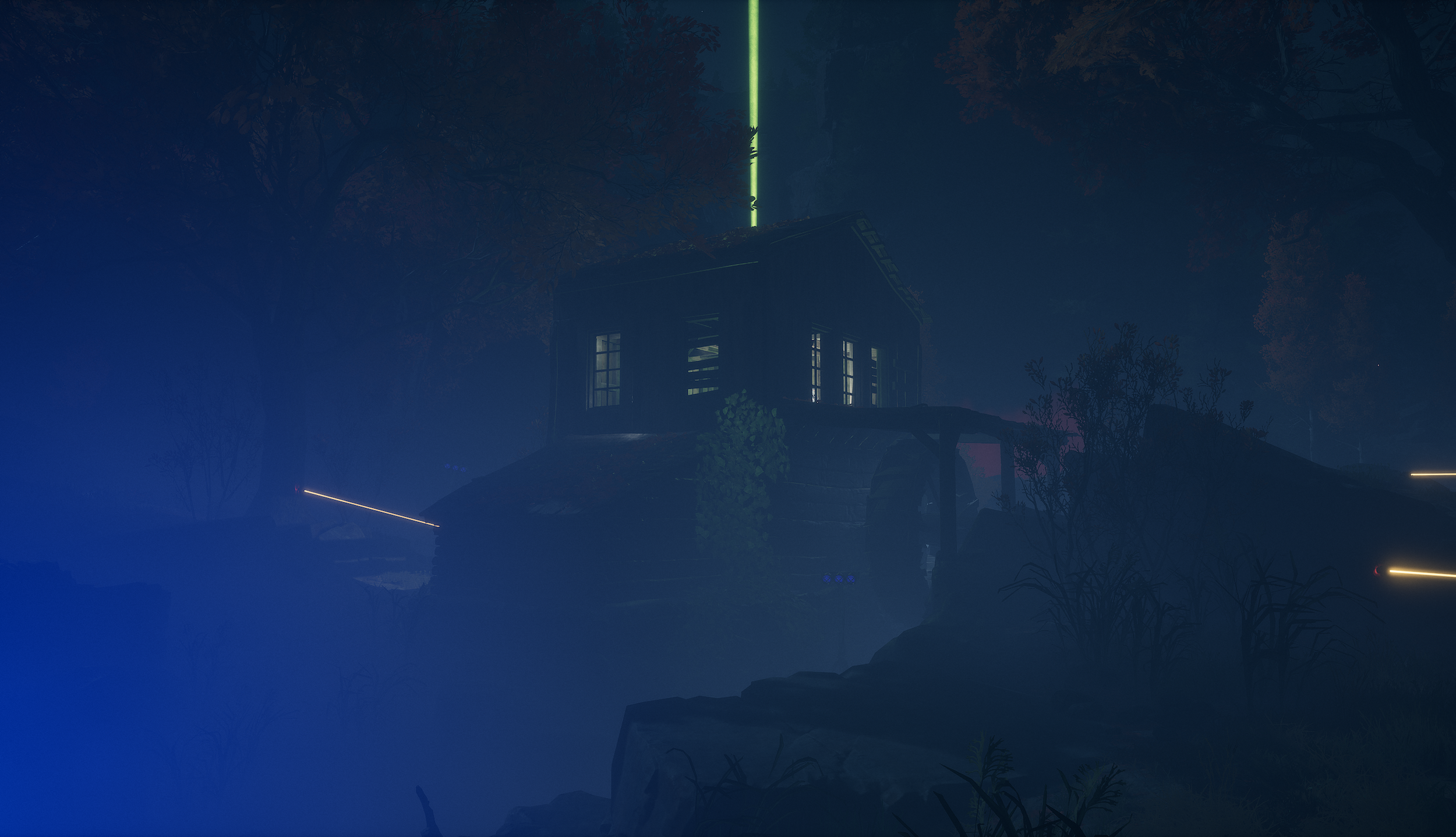

Half Shots were a conceptual spin-off of One Shots which I created in our post-launch phase as we were trying to address criticisms of an encounter barren open world. The idea was to create modular pieces of curated encounter design (such as a scripted ambush, teleporting vampires or a point of interest) that could be placed 3 to 4 times across the game, with different configurations to fit each location. Because these were meant to feel special and hand-crafted, they could only be encountered once per playthrough, but crucially lacked the need for any environment art support or per instance scripting. Essentially a level designer could find an interesting location in the open world, place and configure the Half Shot Smart Object and have built a curated scripted encounter in a matter of minutes.
Initially these started out as quite simple, but overtime grew to support more and more complex behaviors— such as detailed NPC markup for custom actions or even unique NPC variants. We even started to utilize them for adjacent systems, such as friendly turret spawns, or friendly outposts. In summary: it could support any self contained state-dependent open world item.
Scripting wise I was a sole person responsible for building the underlying system, which had to work with our grid streamed open world, multiplayer, as well as persist state correctly. In total I created and maintained 12 of these, which were then placed and configured across the open world ( I believe there are around 70 or so placed in total ).
Below are videos as well as descriptions of some of the Half Shots I created. If you’d like to hear more about the underlying architecture, feel free to contact me.
-
In this Half Shot, players are lured into saving a hostage, when they are then ambushed. Players with a keen eye may also spot the vampires lying in wait.
-
This Half Shot is one of our simpler ones, but we use it to create motion in the world and make the space feel alive. It simply involves scripting a vampire to teleport across 4 perch points in sequence.
-
Here is a more complex Half Shot, an ambush with a squad of 5 soldiers lying in wait. As players approach, three flood lights come on, and the soldiers are scripted to fan out and take position. Crucially in this segment however, I want to show how the same Half Shot Smart Object can be used in two different contexts to drastically different effect— with the smart object itself supporting configurations for different enemy types and behaviors. Please compare both videos with the understanding that they share the same core logic.
For a designer in an open world context, this type of tool is really powerful, as these can be placed in a matter of minutes and quickly breath life into interesting locations.
-
In this Half Shot, players are jumped by a horde of Vampire Shades while lost in a deep fog. I wanted to do something that thematically reinforced our themes of horror, as well as one of our villains, Miss Whisper who is the vampire Goddess of Fog.
-
In this Half Shot players are signaled to check out a supply drop by a flare firing high into the sky. Once completing the encounter, players are then able to loot the supply crate for rare weapons and equipment.